

Introduction
The Steelers vs Las Vegas Raiders match player stats revealed an intense battle of strategy, skill, and determination. The Pittsburgh Steelers showcased their superior gameplay and execution in a highly anticipated matchup that ended with a decisive 32-13 victory. This contest not only emphasized the Steelers’ strength in both offensive and defensive play but also highlighted areas where the Raiders struggled to keep pace. From quarterback precision to defensive resilience, every aspect of the game was a lesson in tactical football.
In this comprehensive breakdown, we’ll explore the most crucial player statistics, analyze individual performances, and uncover the pivotal factors that shaped this outcome. Let’s delve into the numbers, the plays, and the strategies that made this clash a defining moment of the season — and what it means for both franchises moving forward.
The Game Overview: A Battle of Strategy and Skill
The game between the Pittsburgh Steelers and Las Vegas Raiders was more than just a regular-season showdown — it was a statement. The Steelers entered the field with a sense of purpose, determined to prove their dominance after a mixed start to the season. From the first quarter, they set the tempo with strong defensive plays and consistent offensive drives.
The Raiders, on the other hand, struggled to find rhythm. Their offense, led by a talented quarterback, failed to penetrate the Steelers’ formidable defense. By halftime, Pittsburgh had already built a commanding lead, and their momentum carried through to the final whistle.
Statistically, the Steelers controlled possession for over 35 minutes, outgained the Raiders in total yardage, and forced multiple turnovers. Each of these elements contributed to a performance that was both disciplined and dynamic.
First Half Analysis: Steelers’ Early Control
The first half set the tone for the rest of the game. Pittsburgh’s offensive unit, led by an efficient quarterback performance, quickly took advantage of Las Vegas’ defensive gaps. The running game complemented the aerial attack perfectly, allowing the Steelers to sustain drives and dominate time of possession.
Defensively, the Steelers’ front line was relentless. Their pass rush pressured the Raiders’ quarterback into hurried decisions, leading to incomplete passes and crucial mistakes. By the end of the second quarter, the Steelers had established a comfortable lead, and their confidence was palpable.
The Raiders, though capable of explosive plays, were stifled by tight coverage and a disciplined secondary. Their inability to convert on third downs became a recurring problem — one that would haunt them throughout the match.
Second Half: Steelers Seal the Victory
The second half was a continuation of Pittsburgh’s supremacy. Their adjustments at halftime focused on maintaining composure and preventing big plays from the Raiders. The defense stepped up even further, recording key sacks and interceptions that killed any potential comeback hopes for Las Vegas.
On the offensive end, the Steelers mixed run-heavy drives with precision passing, methodically wearing down the Raiders’ defense. Every possession counted, and by the time the fourth quarter rolled around, the outcome was all but decided.
The Raiders managed to score a late touchdown, but it was more a consolation than a comeback. The 32-13 final score reflected not only Pittsburgh’s dominance but also their tactical efficiency.
Key Player Performances
Let’s break down the standout individual performances that defined this matchup.
| Player | Team | Position | Key Stats |
|---|---|---|---|
| Kenny Pickett | Steelers | QB | 240 passing yards, 2 TDs, 0 INT |
| Najee Harris | Steelers | RB | 95 rushing yards, 1 TD |
| George Pickens | Steelers | WR | 6 receptions, 110 yards, 1 TD |
| T.J. Watt | Steelers | LB | 2 sacks, 1 forced fumble |
| Jimmy Garoppolo | Raiders | QB | 205 yards, 1 TD, 2 INTs |
| Josh Jacobs | Raiders | RB | 48 rushing yards |
| Davante Adams | Raiders | WR | 7 receptions, 92 yards, 1 TD |
Each player brought their unique strengths to the field, but it was Pittsburgh’s balance and cohesion that made the difference.
Quarterback Showdown: Pickett vs Garoppolo
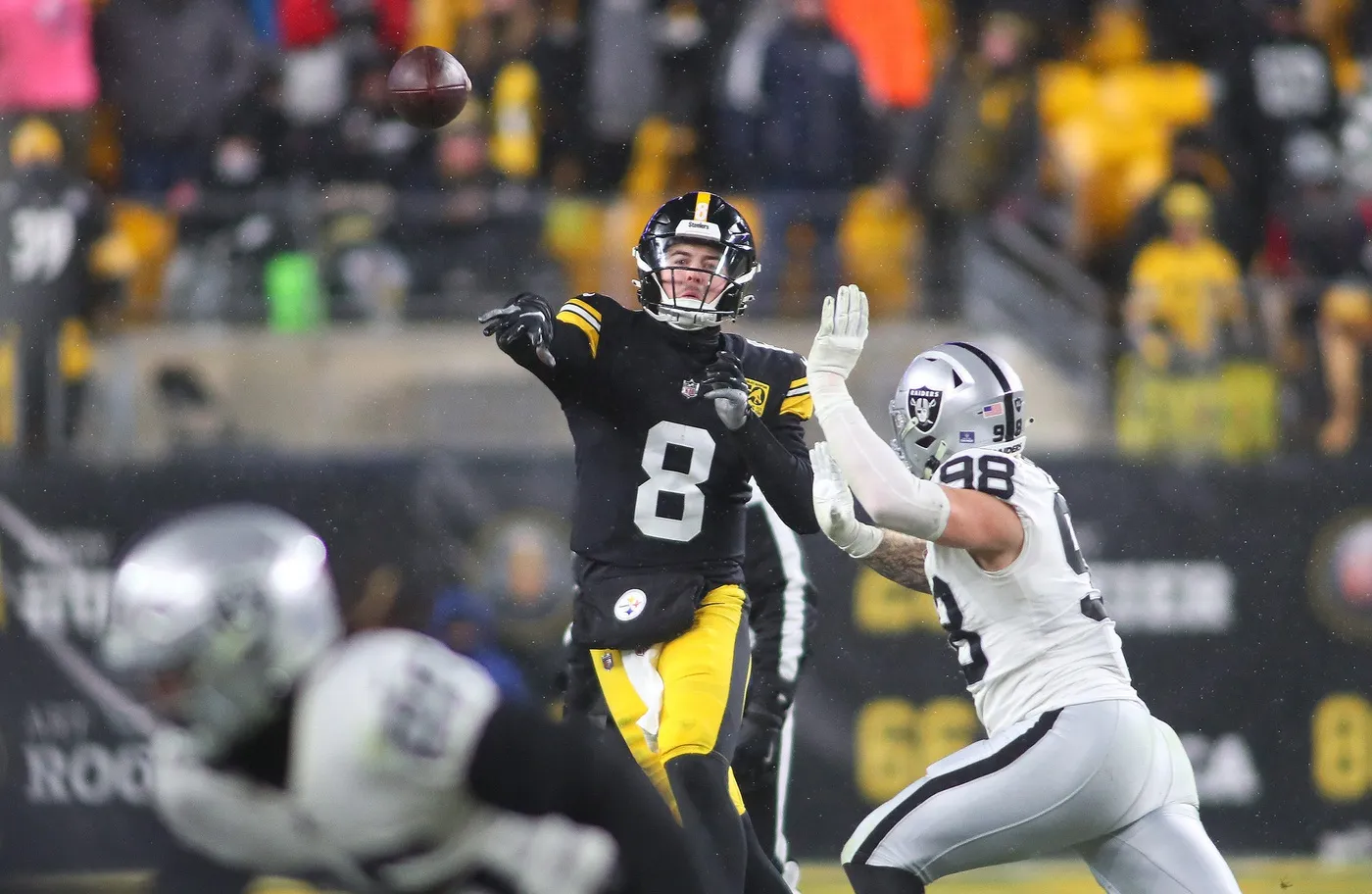
The quarterback battle was a tale of two contrasting performances. Kenny Pickett demonstrated composure, confidence, and accuracy throughout the game. His ability to read the defense and adjust plays at the line of scrimmage kept the Raiders off balance. With 240 yards and two touchdown passes, Pickett was undoubtedly one of the stars of the night.
On the flip side, Jimmy Garoppolo struggled under pressure. The Steelers’ pass rush limited his options and forced errors. Despite a respectable yardage total, his two interceptions were costly, halting potential scoring drives and shifting momentum firmly toward Pittsburgh.
This QB comparison underscored how preparation, adaptability, and protection in the pocket can dramatically influence a game’s outcome.
The Running Game: Ground Control and Time Management
Running the football effectively has always been central to Pittsburgh’s identity, and this game was no exception. Najee Harris led the charge, combining power and patience to exploit holes in the Raiders’ defensive line. His 95 rushing yards and one touchdown reflected not just skill but also excellent blocking from the offensive line.
The Raiders’ ground attack, in contrast, never found traction. Josh Jacobs, usually a reliable workhorse, was held to under 50 yards. The inability to establish the run made Las Vegas one-dimensional, allowing the Steelers’ defense to anticipate passing plays and increase their pass-rush aggression.
Defensive Masterclass by the Steelers
The Steelers’ defense was the backbone of this victory. From the first snap, T.J. Watt, Minkah Fitzpatrick, and the rest of the defensive unit set the tone with physicality and precision. The linebackers maintained pressure throughout, while the secondary executed tight coverage schemes that limited deep passes.
Notably, the Steelers forced multiple turnovers — a fumble recovery and two interceptions — that directly led to scoring opportunities. This opportunistic play highlighted their defensive depth and discipline.
For the Raiders, despite valiant efforts from players like Maxx Crosby, the defense struggled to contain Pittsburgh’s balanced offensive strategy. Their secondary appeared overmatched, especially in third-down situations.
Offensive Strategy: Efficiency and Execution
The Steelers’ offensive coordination deserves praise. The play-calling was diverse, alternating between short passes, screens, and inside runs to keep the Raiders guessing. By spreading the ball across multiple receivers, the Steelers ensured that no single defender could dictate coverage.
Their offensive line also played a critical role — giving Pickett ample time in the pocket and opening running lanes for Harris. The line’s performance was one of the most underrated yet crucial elements of the victory.
Raiders’ Struggles: Where It Went Wrong
The Raiders entered the game with potential but failed to execute consistently. Their biggest issue was inconsistency on third downs and red zone inefficiency. Dropped passes, missed assignments, and penalties compounded their problems.
Additionally, the lack of protection for Garoppolo meant fewer opportunities for big plays. Defensively, while the Raiders had moments of resistance, their inability to stop the run and manage clock control hurt them the most.
In essence, the Raiders were simply outplayed, outcoached, and outpaced.
Coaching and Game Management
Both coaching staffs had well-defined game plans, but the Steelers’ execution stood out. Their adjustments at halftime reflected smart situational awareness. Coach Mike Tomlin’s ability to keep the team disciplined and focused underlined his reputation as one of the league’s most experienced leaders.
The Raiders’ coaching, though strategically sound in theory, fell short in adapting mid-game. Missed timeouts, questionable play calls, and a lack of urgency in critical moments highlighted their shortcomings.
Special Teams Impact
While often overlooked, special teams played a vital role in field position. The Steelers’ punter consistently pinned the Raiders deep in their territory, and their kicker was flawless, converting every field goal and extra point attempt. The Raiders, however, struggled with coverage, allowing key returns that shifted momentum toward Pittsburgh.
Turnovers: The Game-Changing Factor
Turnovers often decide games — and this matchup was no exception. Pittsburgh capitalized on every opportunity presented by the Raiders’ mistakes. Two interceptions and a forced fumble led directly to points. This efficiency turned defensive success into offensive rewards.
The Raiders, meanwhile, couldn’t generate similar takeaways, reflecting a lack of defensive opportunism. In elite-level football, such disparities often define outcomes.
Team Comparison Summary
| Category | Steelers | Raiders |
|---|---|---|
| Total Yards | 395 | 285 |
| Time of Possession | 35:12 | 24:48 |
| Turnovers Forced | 3 | 0 |
| Rushing Yards | 130 | 58 |
| Passing Yards | 265 | 227 |
| Sacks | 4 | 1 |
This statistical comparison showcases how the Steelers’ dominance extended across every aspect of the game — from offense to defense and special teams.
What This Victory Means for Pittsburgh
For the Steelers, this win solidifies their standing as serious contenders. It demonstrates balance across all units and reinforces confidence heading into future matchups. Kenny Pickett’s leadership is growing, and the team’s chemistry is undeniable.
More importantly, this victory serves as a morale booster — a reminder that when execution aligns with preparation, Pittsburgh is one of the toughest teams to beat.
Implications for the Raiders
The Raiders must reassess their offensive approach and improve protection for Garoppolo. Defensive restructuring, especially in secondary coverage and tackling discipline, will also be key. While the defeat is disappointing, it offers valuable lessons for midseason adjustments.
Conclusion
The Steelers vs Las Vegas Raiders match player stats paint a clear picture of Pittsburgh’s dominance and the Raiders’ struggles. From precise quarterback play to relentless defense, the Steelers executed every phase of the game with precision. The Raiders, though showing flashes of brilliance, couldn’t sustain momentum against a well-prepared opponent.
As the season progresses, both teams will look to build upon this game — the Steelers aiming to continue their winning momentum, and the Raiders striving to correct their course. In the end, this matchup was a testament to preparation, execution, and the undeniable power of teamwork.
FAQs
Q1: Who was the standout player in the Steelers vs Raiders game?
A1: Kenny Pickett stood out as the game’s MVP, delivering 240 passing yards and two touchdowns without any interceptions.
Q2: What was the final score of the Steelers vs Raiders game?
A2: The final score was 32-13, with the Pittsburgh Steelers emerging victorious.
Q3: How did the Steelers’ defense perform?
A3: The Steelers’ defense dominated the game, forcing three turnovers, recording four sacks, and keeping the Raiders’ offense under control.
Q4: What were the key stats that decided the game?
A4: Time of possession, turnovers, and rushing yards were decisive factors — all categories where the Steelers outperformed the Raiders.
Q5: What’s next for both teams?
A5: The Steelers aim to build on this momentum, while the Raiders need to improve their offensive consistency and defensive resilience before their next matchup.